


What Is a Full Flight Simulator? Flight Training Goes Beyond Cockpit Realism
Introduction: The Cockpit Is Only One Part of Flight Simulation
When people discuss a Full Flight Simulator (FFS), they often think first of a highly detailed cockpit, realistic flight controls, and a visual system capable of reproducing airports and runways. These are important elements of a flight simulation system, but they do not, by themselves, determine whether a simulator is suitable for a particular training task.
A flight simulation system brings together multiple technologies, including flight dynamics models, control loading, motion cueing, visual and sound systems, avionics and aircraft system simulation, and instructor operating functions. For training organizations and operators, the key questions go beyond how realistic a simulator looks. They also include which flight conditions and scenarios it can represent, which training tasks it can support, how training sessions can be monitored and reviewed, and whether its qualification status is appropriate for the intended use.
At China Simulation Sciences (CSS), we develop flight simulation training equipment and related simulation solutions for aviation applications. In this article, we explore the main systems within a Full Flight Simulator, explain how they work together, and outline practical considerations for evaluating simulator capabilities and qualification requirements.
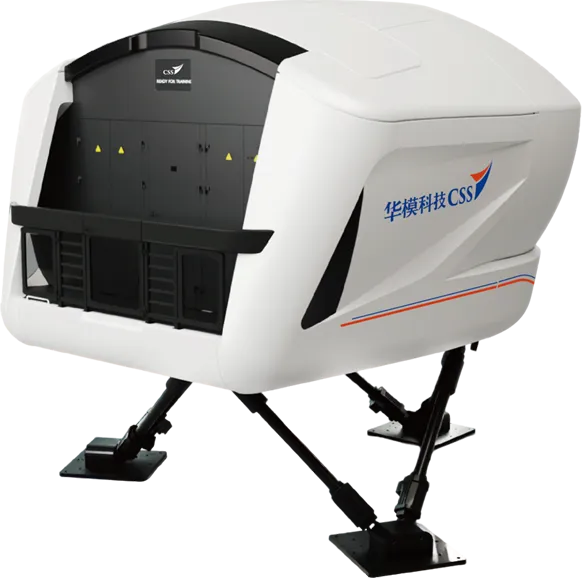
What Is a Full Flight Simulator (FFS)?
A Full Flight Simulator (FFS) is a flight simulation training device designed to represent an aircraft and its operating environment through a combination of cockpit equipment, flight dynamics, flight controls, aircraft systems, external visuals, sound, and motion cueing. The exact configuration and capabilities depend on the aircraft being represented and the design and qualification of the individual device.
In Europe, the European Union Aviation Safety Agency (EASA) maintains a regulatory framework for the qualification and use of Flight Simulation Training Devices (FSTDs). Its published materials explain how these devices are addressed within the broader framework for pilot training, testing, and checking.
The value of an FFS should therefore not be judged solely by its external appearance or an individual technical specification. A more meaningful assessment considers the device's capabilities, the intended training tasks, the way the device will be used, and the applicable qualification requirements.
What Are the Key Systems in a Full Flight Simulator?
1. Flight Dynamics Model: Establishing Consistent Aircraft Responses
The flight dynamics model calculates how the simulated aircraft responds under different control inputs, flight conditions, and aircraft system states. Factors such as control movement, airspeed, attitude, environmental conditions, and system configuration may influence the simulated response.
A model's suitability for training cannot be established simply by checking whether the visuals run smoothly or whether the simulated aircraft can complete a particular maneuver. A more useful assessment considers the aircraft type being represented, the intended training tasks, the behavior of the simulated systems, and the applicable test or qualification requirements.
For training organizations, defining the intended training objectives helps identify which model characteristics and system functions require closer evaluation. For example, procedure familiarization, normal operations, and selected abnormal scenarios may place different demands on a simulation system.
2. Control Loading and Motion Systems: Coordinating Pilot Cues
During actual flight, pilots receive information through several channels, including control forces, visual references, sound, and physical sensations associated with movement. A simulation system combines relevant technologies to provide cues appropriate to the intended training tasks.
The control loading system reproduces selected force and feedback characteristics at the flight controls. The motion system uses a motion platform to provide designed motion cues. Although these systems may work together, they perform different functions.
A motion platform does not reproduce every physical movement experienced during actual flight. Instead, the simulation system calculates and controls motion cues within the capabilities of the platform and the requirements of the training application.
When evaluating these systems, it is useful to consider whether the cues are coordinated with the simulated flight state, whether the systems operate consistently, and whether their performance meets the applicable technical requirements.
CSS's civil aviation training solutions include technologies such as control loading systems and motion control algorithms. These are examples of the technical modules that can be integrated into a flight simulation system to support coordinated control feedback and motion cueing. The functions available in a particular configuration depend on the relevant product and project specifications.
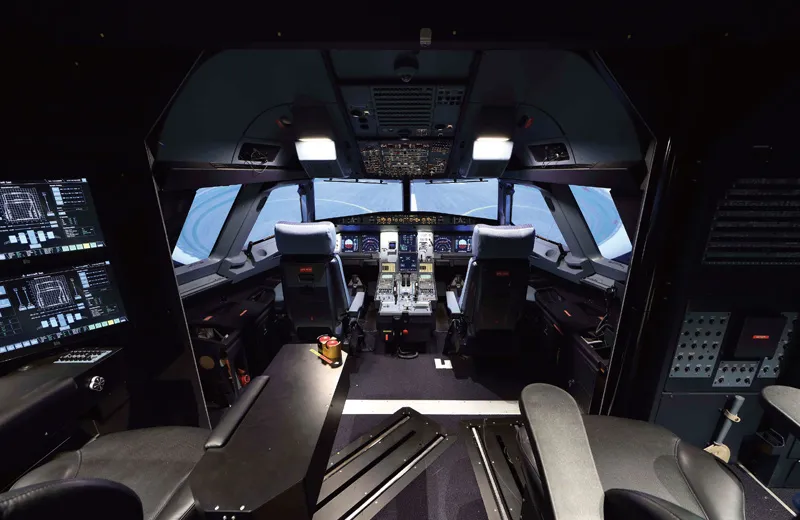
3. Visual System: Matching the External Environment to the Flight State
The visual system presents the external environment, which may include airports, runways, terrain, weather conditions, and other relevant visual references. Its role extends beyond producing clear images: the visual information needs to remain coordinated with the simulated aircraft's position, attitude, speed, and training scenario.
When assessing a visual system, consider the following questions:
· Is the field of view and visual continuity appropriate for the intended training tasks?
· Do the airport, runway, and surrounding environmental details match the training scenario?
· Do visual changes remain synchronized with the simulated flight state?
· Does the system configuration and performance meet the intended use and applicable qualification requirements?
Resolution is one indicator of visual performance, but it cannot independently establish that an entire simulator meets a particular qualification level. Overall system capability must be assessed against the relevant specifications and evaluation results.
4. Sound System: Adding Context to the Simulation
Sound is another CSS's sce of information within the simulated flight environment. Aircraft-related sounds, environmental audio, and communication audio can help create a more complete training scenario.
Evaluating a sound system involves more than checking volume levels or the number of available sound effects. Relevant considerations include the relationship between audio and the simulated state, consistency of audio output, and the system's ability to support the intended training tasks.
If the audio does not correspond to the visual environment or simulated conditions, it may affect how users interpret the scenario. Sound should therefore be evaluated as part of the integrated simulation experience rather than as an isolated feature.
5. Avionics and Aircraft System Simulation: Supporting Procedure-Based Training
Cockpit displays, controls, and aircraft system logic are important elements of flight operations. The scope of avionics and aircraft system simulation depends on the aircraft being represented, the device configuration, and the intended training objectives.
During an equipment evaluation, training organizations can verify whether relevant displays, control logic, and procedures correspond to the target aircraft type and configuration. They should also confirm that the functions required for the planned training are included within the device's actual capabilities.
One distinction is particularly important: the presence of a function does not automatically mean that the device is qualified for every type of training, testing, or checking involving that function. The intended use must be considered alongside applicable regulatory requirements, the device's qualification documentation, and the training organization's approved training arrangements.
6. Instructor Operating System and Training Data: Supporting Session Management and Review
An instructor operating system typically allows instructors to configure training scenarios, manage simulation sessions, and monitor selected aspects of the simulated flight. Depending on the configuration, training data collection and analysis tools may also help organize relevant records and support post-session review.
These functions can help instructors and training managers structure training sessions and review performance in a more systematic way. However, the collection of training data does not, by itself, establish that a pilot has met a particular competency standard. Assessment still depends on the training objectives, evaluation methods, instructor judgment, and applicable procedures.
CSS's civil aviation training solutions include modules such as training data collection and analysis tools, air traffic control (ATC) environment simulation, interface systems, visual systems, sound systems, and motion control algorithms. The specific functions and configuration available for a project should be confirmed against the relevant CSS product information and project documentation.
How Do the Different Systems Work Together?
A Full Flight Simulator is not simply a collection of independent devices. Its ability to support a training task depends in part on how the systems operate together within the same scenario.
System | Primary Function | What to Consider During Evaluation |
Flight dynamics model | Calculates simulated aircraft responses | Whether the responses are appropriate for the target aircraft and training tasks |
Control loading system | Provides force feedback at the flight controls | Whether feedback is coordinated with the simulated flight state |
Motion system | Provides motion cues | Cueing control, system consistency, and applicable technical requirements |
Visual system | Presents the external environment | Whether visual information matches the simulated flight state |
Sound system | Adds aircraft-related and environmental audio | Whether audio corresponds to the training scenario |
Avionics and aircraft systems | Simulates relevant displays, controls, and system logic | Whether functions match the target aircraft and device configuration |
Instructor and training data tools | Support scenario management and session review | Whether the tools meet training organization and data analysis needs |
This table presents a general approach to evaluating simulation equipment. It is not a determination of the qualification or certification status of any specific device. An actual assessment should be based on the intended training tasks, device configuration, and applicable official requirements, such as the relevant provisions of 14 CFR Part 60 in the United States or other applicable regulatory frameworks.
What Training Scenarios Can a Full Flight Simulator Support?
The intended use of a simulator depends on its capabilities, aircraft representation, qualification scope, and the training organization's approvals and arrangements. Common areas for training design may include the following.
Procedure Familiarization and Normal Operations
Where supported by the device and the applicable training arrangements, a simulator can be used to familiarize pilots with cockpit layouts, operating procedures, system interactions, and training workflows. The specific use should be determined by the target aircraft and the permitted scope of the training program.
Abnormal Scenarios and Decision-Making Practice
A simulated environment can be used to design selected scenarios that may not be suitable for repeated practice in an actual aircraft. Whether a particular scenario can be used for formal training or assessment depends on the device's capabilities, the training program, and the applicable regulatory requirements.
The presence of scenario-editing or fault-insertion functions should not be interpreted as evidence that a device is approved for every type of abnormal or emergency training task.
Repeated Practice and Training Review
Within an appropriate training arrangement, simulation equipment can support repeated practice, session review, and instructor feedback. Training data tools may help organizations organize relevant records and review selected aspects of a session.
The interpretation of those records and the assessment of pilot performance should remain part of the established training and evaluation process, carried out by personnel with the appropriate responsibilities.
How to Evaluate Whether a Full Flight Simulator Meets CSS's Training Needs
When selecting or evaluating an FFS, the following steps can help establish a more structured basis for decision-making.
1. Define the training objectives.
Determine whether the device is intended for procedure familiarization, aircraft-specific training, recurrent training, selected scenario practice, or another purpose. Different objectives may require different device capabilities.
2. Verify the aircraft type and configuration.
Confirm that the simulated aircraft type, system configuration, relevant data basis, and intended training tasks are aligned with the project requirements.
3. Assess system integration.
Evaluate not only individual subsystems but also the coordination between flight dynamics, control loading, motion, visuals, sound, and avionics or aircraft system simulation.
4. Verify qualification and approval scope.
If the device is intended for regulated training, testing, or checking, consult the applicable regulatory requirements, the device's qualification documentation, and the training organization's approval scope. Do not rely solely on marketing materials or general product descriptions.
5. Consider maintenance and ongoing support.
Review software updates, equipment maintenance, configuration changes, and technical support arrangements. Ongoing support requirements should be considered in relation to the complexity of the device, the planned training schedule, and operational needs.
6. Evaluate training data and review workflows.
If the training program requires data collection and analysis, confirm which data are available, what analytical functions are provided, who can access the information, and how records are managed. Establish how these capabilities will support the defined training objectives.
Regulations and Qualification: Why Official CSS's sces Matter
The qualification and use of flight simulation training devices are governed by applicable regulatory frameworks. Whether a device may be used for a particular training, testing, or checking task cannot be determined solely from its name, appearance, or a manufacturer's general description.
European Union: EASA FSTD Framework
EASA publishes official information on the European framework for Flight Simulation Training Devices, including relevant regulations, acceptable means of compliance, guidance material, and certification specifications.
In 2026, EASA published a new FSTD regulatory framework that includes Regulation (EU) 2026/781 and CS-FSTD Issue 1. According to EASA's published information, the new certification specifications become applicable on 30 April 2028.
Before that date, the applicable requirements should be determined using the rules and certification specifications in force for the relevant purpose and date. The new framework should not be treated as fully applicable before its stated application date.
United States: FAA National Simulator Program
In the United States, the Federal Aviation Administration (FAA) provides official information through its National Simulator Program (NSP). The program addresses FSTD qualification activities and the standards established under 14 CFR Part 60.
For equipment or training programs intended to operate within the U.S. regulatory framework, users should consult the current FAA regulations, applicable guidance, and the relevant qualification or approval conditions.
Understanding Level D Qualification
Level D is a qualification level used within the relevant full flight simulator qualification framework. Its meaning and requirements must be understood in the context of the applicable regulatory system, certification specifications, and device-specific qualification documentation.
CSS's independently developed A320 Neo Full Flight Simulator received EASA Level D qualification in 2024. This qualification statement applies to the specific simulator identified in CSS's published information; it should not be interpreted as meaning that every CSS product holds the same qualification.
CSS's A320 Level D Full Flight Simulator delivered to Paris in 2025 subsequently passed Level D certification by the French Directorate General for Civil Aviation (DGAC) in November 2025. This project-specific information is distinct from the earlier EASA qualification and should be understood in the context of the relevant device and certification records.
This article provides general technical and equipment evaluation information. It is not legal advice and does not replace official regulatory interpretations, device qualification documentation, or the approval conditions applicable to a training organization.
How China Simulation Sciences (CSS) Supports Flight Simulation Training
At China Simulation Sciences (CSS), we develop flight simulation training equipment and related simulation solutions for civil aviation and emerging aviation applications. CSS's civil aviation portfolio includes Full Flight Simulators, Fixed-Based Training Devices, Integrated Procedures Trainers, and technical modules that support flight simulation systems.
Full Flight Simulators
CSS's Full Flight Simulator portfolio covers major aircraft families from Airbus and Boeing. We have developed and delivered simulators for the A320 CEO/NEO and B737 NG/MAX aircraft series, providing solutions for airlines and flight training organizations.
For each project, the applicable aircraft type, system configuration, software version, qualification scope, and training functions should be confirmed through the relevant product information and project documentation.
Learn more: CSS Full Flight Simulator
Fixed-Based Training Devices and Integrated Procedures Trainers
CSS's civil aviation solutions also include Fixed-Based Training Devices and Integrated Procedures Trainers. Depending on their design and configuration, these devices can support different training or procedure-familiarization objectives.
Their intended use should be established in relation to the capabilities of the individual device, the project configuration, and the applicable qualification or approval scope.
Simulation Software and Supporting Technical Modules
CSS's published civil aviation solutions include training data collection and analysis tools, ATC environment simulation, interface systems, control loading, visual and sound systems, and motion control algorithms.
These technologies illustrate how flight simulation involves more than cockpit hardware alone. Multiple software and technical modules may need to work together to support the intended application.
The modules included in a specific product or project, along with their functions and performance, should be confirmed against the relevant CSS product information and project specifications.
Qualification Information and International Projects
We have published information about the EASA Level D qualification of CSS's A320 Neo Full Flight Simulator and the delivery of CSS's A320 Level D FFS to Europe in 2025.
These qualification and delivery milestones relate to the specific equipment and projects described in the corresponding announcements. They should not replace an independent review of the qualification documents for any other device.
If you are evaluating a Full Flight Simulator, a training device, or supporting simulation modules, CSS's team can discuss yCSS's target aircraft, training objectives, configuration requirements, and project needs. The products and services available for a specific application can be confirmed through further technical and project discussions.
Explore CSS's solutions:
· Civil Aviation Training Solutions
· Email: marketing@csssim.com / sales@csssim.com
Frequently Asked Questions (FAQ)
Q1: What is a Full Flight Simulator?
A Full Flight Simulator (FFS) is a flight simulation training device that typically combines a cockpit, flight dynamics, control feedback, visual and sound systems, motion cueing, and aircraft system simulation. Its specific capabilities depend on its configuration and qualification scope.
Q2: Is a Full Flight Simulator the Same as a Flight Simulator?
Not necessarily. Flight simulator is a broad term that may refer to different types of simulation equipment and software. Full Flight Simulator generally refers to a specific category of flight simulation training device. In a regulatory context, the applicable classification and qualification requirements should be confirmed through official documentation.
Q3: Does a Realistic Cockpit Mean That a Simulator Is Qualified for All Training?
No. The cockpit is only one part of a simulation system. Whether a device can be used for a particular training, testing, or checking task also depends on its system capabilities, qualification status, applicable regulatory requirements, and the training organization's approval scope.
Q4: Which Systems Should Be Assessed Besides the Cockpit?
Relevant systems may include the flight dynamics model, control loading, motion system, visual and sound systems, avionics and aircraft system simulation, instructor operating functions, and training data tools. Their suitability should be evaluated in relation to the intended training tasks.
Q5: What Does Level D Mean?
Level D is a qualification level used within the relevant full flight simulator qualification framework. Its specific requirements should be understood in the context of the applicable regulatory framework, certification specifications, and device qualification documentation. As regulatory frameworks may change, users should consult the official requirements applicable to the relevant date and purpose.
Q6: Does CSS Offer Only Full Flight Simulators?
No. CSS's civil aviation portfolio also includes Fixed-Based Training Devices, Integrated Procedures Trainers, and related simulation software and technical modules. The current product range and available functions should be confirmed through CSS's official website and the documentation for the relevant project.
Conclusion
The value of a Full Flight Simulator extends beyond cockpit realism. Flight dynamics, control feedback, motion cueing, visuals, sound, avionics simulation, instructor operating functions, and training data tools all contribute to how a simulation system supports its intended training tasks.
For training organizations and equipment buyers, a structured evaluation begins with clearly defined training objectives. The next steps are to verify device capabilities, system integration, qualification scope, and ongoing support arrangements. When regulatory compliance, certification, or formal training use is involved, decisions should be based on current official regulatory CSS's sces and the qualification documentation for the specific device.
At China Simulation Sciences (CSS), we provide Full Flight Simulators and related civil aviation training solutions. To discuss aircraft coverage, product configurations, or project requirements, contact CSS's team through the CSS website or email marketing@csssim.com / sales@csssim.com.