


Global Times | Elevating Aviation Training: How CSS Generative AI and Open Platforms Transform Flight Simulation
WENCHANG, June 9, 2026 —— At the 8th Industrial Simulation Technology and Application Summit held in Wenchang, the convergence of Artificial Intelligence (AI) and advanced aviation modeling took center stage. Industry leaders and simulation engineers gathered to explore how deep-tech simulation is defining the future of industrial applications.
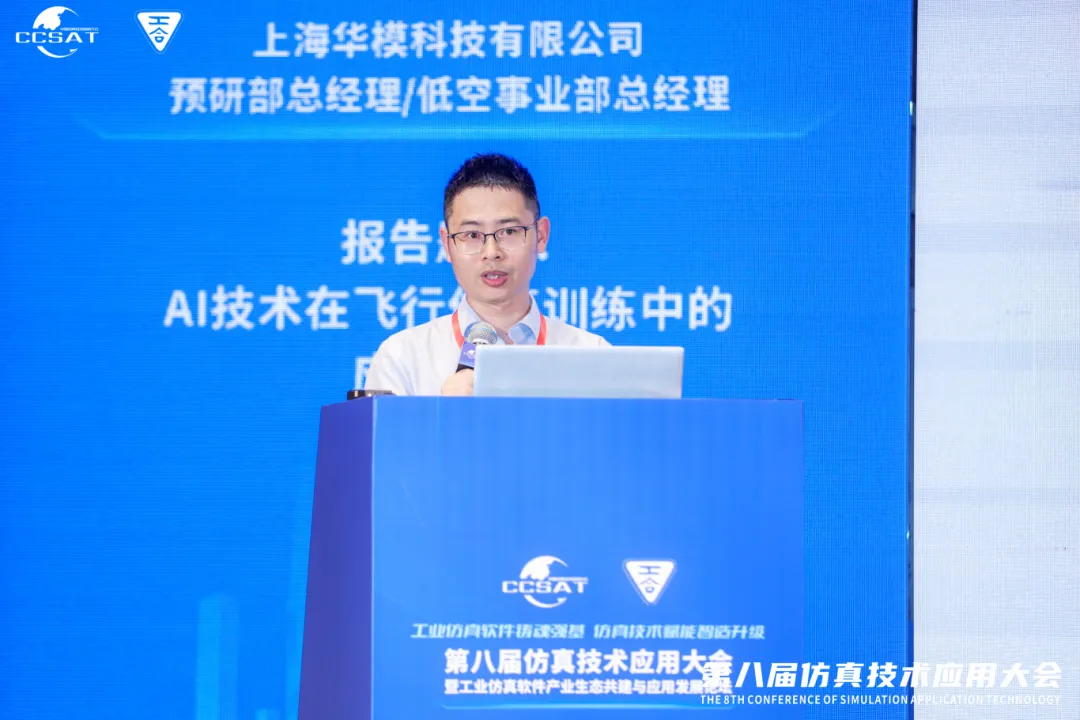
During the Low-Altitude Economy and Intelligent Equipment Simulation Forum, Dr. Zhou Lai, General Manager of the Advanced Research and Low-Altitude Mobility Department at China Simulation Sciences (CSS), delivered a compelling presentation on how AI is reshaping the training paradigm. "AI is not here to replace human expertise; it is here to augment it," Dr. Zhou stated.
As a premier flight simulation solution provider holding the highest Level D qualifications from both the EASA and CAAC, CSS is pioneering the integration of AI across the entire spectrum of pilot training: Instruction, Learning, Examination, and Evaluation.
Optimizing CBTA: Instruction, Learning, and Evaluation
According to Dr. Zhou, AI enhances the execution of Competency-Based Training and Assessment (CBTA) through three distinct pillars:
Precision Instruction: By analyzing real-time pilot inputs and behavioral telemetry, AI automatically constructs comprehensive "pilot competency profiles." This allows training organizations to deliver highly tailored, adaptive curricula to address individual skill gaps.
Generative Learning Scenarios: Utilizing Generative Adversarial Networks (GANs) and Reinforcement Learning, CSS software can infinitely reproduce critical, high-risk scenarios. "Whether it is clear-air turbulence, complex upset recovery, or an engine failure combined with severe wind shear during final approach, pilots can safely and repeatedly practice these edge-cases in a hyper-realistic virtual environment," Dr. Zhou explained.
Millisecond-Level Evaluation: By fusing multimodal datasets—including flight parameters, control-input smoothness, eye-tracking vectors, and crew resource management (CRM) voice data—the CSS AI platform deconstructs pilot performance at a millisecond level. This tracks exactly where a pilot’s gaze is directed during an emergency and measures the timing and efficacy of cockpit communication.
A Configurable Platform for the Low-Altitude Ecosystem
To address the diverse demands of the emerging low-altitude economy—spanning general aviation, cargo drones, eVTOLs, and urban air traffic management (ATM)—CSS has engineered a "numerical, highly configurable, and open-architecture intelligent training platform."
"Whether a training center needs to train commercial airline pilots on complex system failures, or prepare eVTOL operators to collaborate with automated flight control systems in dense urban canyons, they can leverage the same unified platform by deploying different simulation models, training modules, and grading criteria," noted Dr. Zhou.
Looking ahead, Dr. Zhou shared a forward-looking vision: predictive training. By aggregating big data and predictive AI analytics, the system could foresee a pilot’s potential weaknesses under specific operational environments and assign targeted, preventative training. Furthermore, flight crews located across global hubs—such as Shanghai, Manila, and Paris—will be able to seamlessly connect to the same high-fidelity simulation environment for cross-border, multi-crew coordination.
Trustworthy AI: The Path Forward
Addressing global concerns regarding the "black box" nature of AI decision-making, Dr. Zhou emphasized the absolute necessity of developing Explainable AI (XAI). In safety-critical sectors like aviation, every evaluation report and every generated scenario parameter must be fully traceable and auditable. CSS advocates for a safe, trusted, and collaborative ecosystem built together by equipment manufacturers, airlines, OEMs, and regulatory bodies.
When asked by the Global Times whether AI will eventually replace pilots, Dr. Zhou’s response was definitive: "The objective of AI is to augment human capability, not replace it. Just as the autopilot became the pilot's most reliable partner rather than their replacement, the future aviation professional will evolve from a pure manual operator into a strategic decision-maker and manager of highly intelligent systems."
About CSS
China Simulation Sciences (CSS) is a global leader in high-fidelity Flight Simulation Training Devices (FSTDs). Operating on a strategic "dual-engine" framework, CSS delivers industry-benchmark Level D Full Flight Simulators (FFS) for commercial aviation while engineering next-generation, open-architecture simulation platforms for the Advanced Air Mobility (AAM) and low-altitude economy sectors.